When International Enrollment Falls, Do American Students Actually Win?

⚡ Article at a glance
Short on time? Here's the entire article in 30 seconds.
Argument 1 — "International students take seats from Americans." → Mostly wrong. International tuition funds domestic seats rather than competing for them. And with domestic enrollment down about 2 million students since 2010, seats aren't scarce — they're increasingly empty. Universities losing international students are cutting programs and raising tuition, not admitting more Americans.
Argument 2 — "OPT and H-1B take jobs from American graduates." → It's complicated. These are two different programs, and the strongest criticisms apply to specific H-1B employer practices, not to students. Meanwhile, OPT expansions increased domestic STEM degrees, and visa restrictions tend to move jobs overseas rather than hand them to American workers.
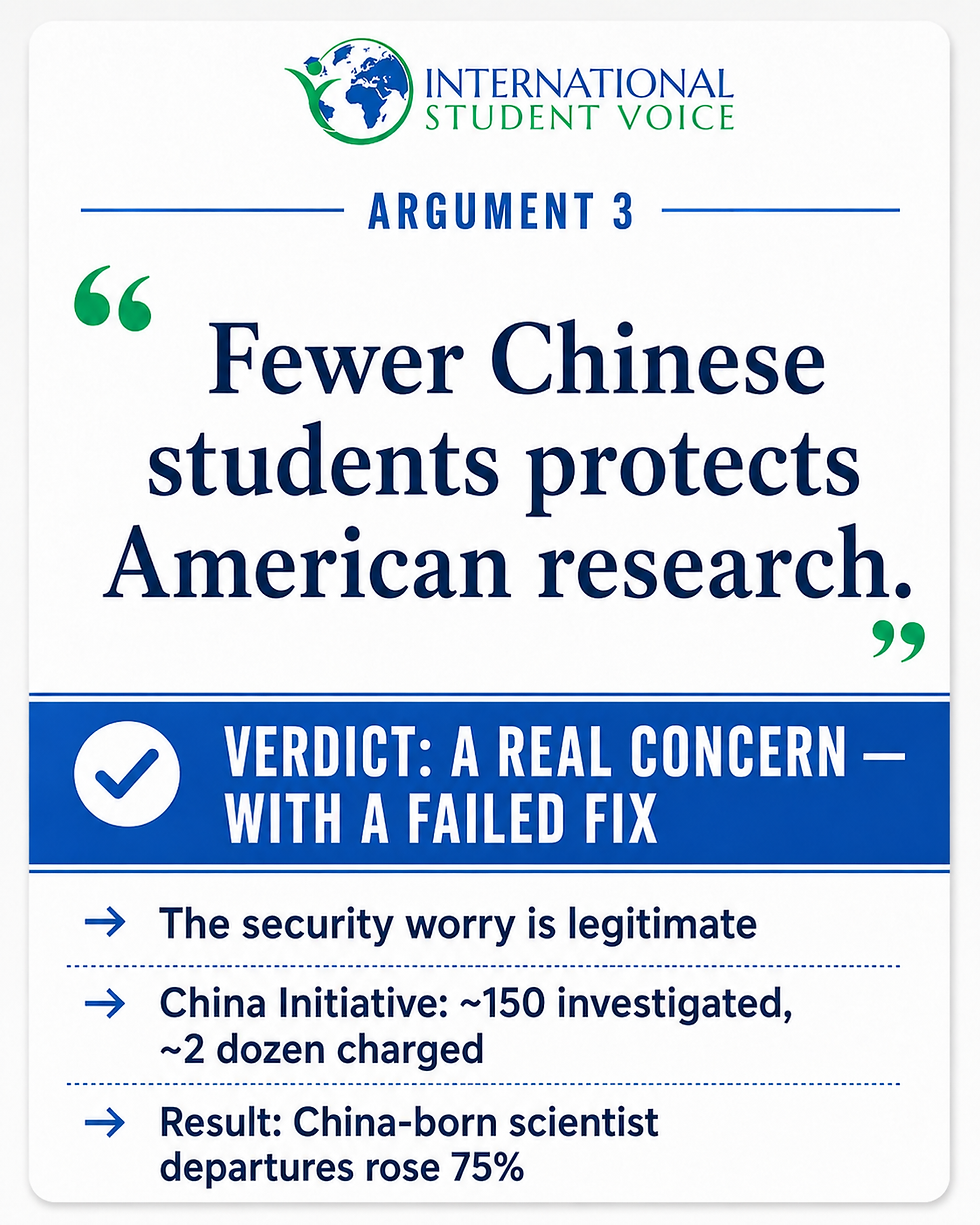
Argument 3 — "Fewer Chinese students protects American research." → A real concern, with a solution that already failed. Research security genuinely matters. But when the U.S. tried broad enforcement through the China Initiative, departures of China-born scientists rose 75 percent — the opposite of the intended result.
The bottom line: A small number of American students at a small number of elite schools did gain seats. Most American students are at institutions cutting majors, laying off advisers, and charging more.
_____
Last week, I laid out the case for fewer international students in the United States.
Not because I agree with it.
Because the Center for Immigration Studies and organizations like it are shaping the rules international students are living under right now... and you can't respond to a policy you don't understand.
I know...I know...when a regulation upends your degree plan or your work authorization, sitting down to study the reasoning behind it feels like the last thing you want to do.
But here's the thing...
Just saying, "You're wrong" has never changed a single mind.
We need to clearly understand the arguments for fewer student visas and be able to articulate why they are not accurate...or perhaps...accurate.
So this week, I went to work.
The entire case rests on one assumption: That when an international student doesn't get a visa, an American student gains something. A seat. A scholarship. A research position. A job.
Does that actually happen?
I went looking for evidence — peer-reviewed studies, federal enrollment data, university budget announcements. Here's what I found, argument by argument, with a verdict on each.
(Fair warning: one of them holds up better than the others. I'm not going to pretend otherwise.) 😬
📚 Argument 1: "International students take seats away from Americans"

The claim
Selective universities have a limited number of seats. Graduate programs have limited funding, faculty attention, and lab space.
Every seat given to an international student is a seat an American didn't get.
It's an intuitive argument. Most of us have some experience with a thing that ran out.
What the evidence shows
The problem is that the "fixed seats" premise doesn't survive contact with how universities are actually funded.
Economist Kevin Shih studied this directly in the Journal of Public Economics. He found that international graduate students don't crowd out domestic students — they crowd them in.
His estimate: for every 10 additional international graduate students, there were about 8 additional domestic graduate students.
Why? Because international students pay significantly more, and that money funds seats.
And we know exactly what universities were using that money to patch. Research published in the American Economic Journal: Economic Policy by Bound, Braga, Khanna, and Turner found that between 1996 and 2012, a 10 percent cut in state appropriations led to a 16 percent increase in foreign enrollment at public research universities.
Read that again, because it reverses the story.
International students weren't displacing Americans. They were backfilling a hole state legislatures dug.
A Princeton study puts the proportions in perspective: international students make up about 6 percent of enrollment but 12 percent of revenue at U.S. colleges... and more than 30 percent of revenue at the institutions most dependent on them.
Part of that gap is discounting. Roughly 16 percent of domestic undergraduates pay the full sticker price. More than 80 percent of their international classmates do.
And now we have the natural experiment
Here's what makes this argument testable in a way it wasn't two years ago.
International enrollment is falling. So we can stop theorizing and just... look.
At the University of North Texas, 2,800 international students who were expected simply didn't show up. The university went $45 million into the red and eliminated 71 academic programs.
Those 71 programs were not international student programs. They were programs.
Elsewhere:
Northwestern eliminated 425 positions, froze hiring, and delayed building projects
USC cut nearly 1,000 jobs — including academic advisers
DePaul laid off 114 employees after international enrollment fell 30 percent
Since January 2024, the tracking database CollegeCuts has logged more than 300 instances of universities eliminating programs, closing departments, or laying off staff.
And most of these schools raised tuition anyway. Syracuse by nearly 4 percent. Northwestern by 3.5 percent. USC to $103,162 for a year.
Then there's the detail that quietly dismantles the "limited seats" premise entirely:
Domestic enrollment has fallen by about 2 million students since 2010.
The seats aren't scarce. Increasingly, they're empty.
If you want to see where this road ends, look at Canada. After a 2024 cap on study permits, international enrollment fell 73 percent. Ontario universities are down about $1.5 billion. As one Canadian higher-ed analyst put it, domestic students there aren't necessarily paying more... they're just getting less.
Where the argument has a point
I promised honesty, so here it is.
Economist George Borjas ran a similar analysis and reached a different conclusion — that international students crowded out white native men specifically in graduate programs. That paper exists. It's serious. The research literature on this question is genuinely mixed, not unanimous.
There's also a structural wrinkle worth knowing: studies in the U.K. found no crowd-out for undergraduates (whose numbers are capped by quota) but crowd-in at the postgraduate level (where they aren't). Which suggests the answer partly depends on whether seats are regulated in the first place.
And in fall 2025, something happened that looks a lot like the crowd-out theory working: a handful of highly selective universities, including Stanford and Duke, made last-minute offers to waitlisted domestic students to fill gaps left by international students who didn't arrive.
So a small number of American students at a small number of elite schools did gain a seat.
That's real. It's just not most students, and it's not most schools.
🔍 The verdict: Mostly wrong — and universities are proving it in real time. At a handful of elite institutions, a few American students got seats they wouldn't have gotten. Everywhere else, the pattern is programs cut, staff laid off, and tuition raised.
💼 Argument 2: "OPT and H-1B take jobs from American graduates"

The claim
A student visa isn't only about education. It's an entry point to the U.S. workforce. OPT lets graduates work for a year — up to three for many STEM graduates. Some move to H-1B, some to permanent residency.
Shrink the pipeline, and American graduates face less competition.
First: these are two different programs
Before anything else... OPT and H-1B get discussed as if they're one thing. They aren't, and the criticism doesn't apply to them equally.
OPT is temporary work authorization tied to your degree. No employer sponsorship, no lottery, no cap.
H-1B is a capped employer-sponsored work visa with a lottery.
The most substantive criticisms of H-1B — that certain staffing and outsourcing firms flood the lottery and use it to undercut wages — are real criticisms made by people across the political spectrum. Those criticisms are about how a specific visa category is used by specific employers.
They are not an argument about OPT. And they're definitely not an argument about whether you should be allowed to study here.
Anyone who blurs those together is doing it on purpose.
What the evidence shows
On wages: Peri, Shih, and Sparber studied 219 U.S. cities from 1990 to 2010 in the Journal of Labor Economics. They found H-1B-driven increases in STEM workers were associated with significant wage increases for college-educated natives — with smaller but still positive gains for non-college-educated workers, and no significant negative effect on employment.
(One honest caveat from that same paper: housing rents rose too, eating into part of those gains.)
On OPT specifically: this is the newest finding, published in AEA Papers and Proceedings in May 2026. Amuedo-Dorantes and Shih examined the staggered STEM-OPT expansions of 2008, 2011, 2012, and 2016.
The result: OPT reforms increased STEM degree completions by 14–15 percent... and domestic completions rose too.
Their conclusion, in their words, is that OPT expansions may have crowded domestic STEM students in rather than out.
On where the job actually goes: this is the argument I find most overlooked.
The assumption is that a job not given to an international graduate becomes a job for an American. But firms have a third option.
Wharton's Britta Glennon studied what companies did when H-1B access tightened. They expanded employment at foreign affiliates and opened new ones — concentrated in Canada, India, and China.
Her finding: for every visa rejection, the average multinational hired 0.4 employees abroad. For the most globalized firms, 0.9.
The jobs hit hardest were R&D-intensive. And U.S. multinationals perform roughly 80 percent of all U.S. research and development.
Glennon's own framing is worth sitting with: even if some native workers are displaced, policies aimed at protecting American jobs should account for the fact that those same policies push jobs overseas.
On job creation: the National Foundation for American Policy found that 24 percent of U.S. billion-dollar companies have a founder who first came here as an international student.
Those immigrant-founded companies average 833 jobs created each.
Where the argument has a point
The entry-level tech job market is genuinely difficult right now. Computer science graduates — American and international alike — are struggling in ways they weren't five years ago.
Telling those graduates that immigration is unrelated to their job search would be dismissive, and I'm not going to do it.
But the research consistently points to a different culprit than headcount competition.
And the offshoring finding suggests that restricting visas may relocate the jobs rather than redistribute them.
🔍 The verdict: It's complicated — and OPT and H-1B are not the same thing. The wage and enrollment evidence runs against the displacement story. The strongest version of this argument is about specific H-1B employer practices... not about students.
🔬 Argument 3: "Fewer Chinese students protects American research"
The claim
Some universities conduct sensitive research. Concerns about intellectual property, technology transfer, and foreign influence are documented and bipartisan.
Fewer student visas in sensitive fields means less exposure.
Let me be direct about this one
This concern is legitimate. I'm not going to wave it away, and you should be skeptical of anyone who does.
Research security is a real policy problem. Governments do try to acquire technology through academic channels. That's not a talking point — it's documented.
The question isn't whether the concern is valid.
The question is whether restricting student visas works.
What the evidence shows
We have an unusually clear answer, because this approach was already tried.
In 2018, the Justice Department launched the China Initiative to address exactly these concerns. Researchers at Princeton, Harvard, and MIT studied what happened and published it in PNAS.
The program openly investigated about 150 academic scientists and criminally charged about two dozen.
Then the outcomes:
Departures of U.S.-based, China-born scientists rose 75 percent
The share of departing Chinese-descent scientists returning to China rose from 48 percent to 67 percent
In life sciences alone, more than 1,000 scientists left in 2021
The researchers also surveyed 1,304 U.S.-based scientists of Chinese descent. 72 percent didn't feel safe as academic researchers. 42 percent were fearful of conducting research at all.
The best-known case: MIT's mechanical engineering department chair, Gang Chen, was arrested in January 2021. His lab closed. His research group scattered.
A year later, all charges were dropped.
The Justice Department ended the China Initiative in February 2022 after an internal review concluded it had created a harmful perception of bias and was stifling scientific research. By then, more than 1,000 academics had signed an open letter asking for exactly that.
So the goal was keeping frontier research in America.
The measurable result was legitimate researchers leaving for China.
Where the argument has a point
Research security genuinely matters. Some fields genuinely warrant scrutiny. Targeted, evidence-based vetting of specific individuals and specific projects is a reasonable thing for a country to do.
The failure of the China Initiative wasn't that it took security seriously. It was that it applied a broad demographic filter to a narrow problem... and lost enormous amounts of talent doing it.
🔍 The verdict: A real concern — with a solution that already backfired once. The security worry is legitimate. Broad visa restrictions are a poor tool for it, and we have the data to say so.
🎯 So... do American students actually benefit?
Here's my honest answer.
A small number, at a small number of schools, yes. If a waitlist at a highly selective university moved because international students didn't arrive, someone real got a seat.
For most American students, no. They're at institutions cutting programs, laying off advisers, and raising tuition — because a revenue source that was quietly subsidizing them disappeared.
The uncomfortable part is that both things are true at once. And the students most likely to gain are the ones with the most options already... while the students most likely to lose are at regional publics and mid-sized privates where a budget gap turns into a canceled major.
There's also a version of this that isn't about students at all.
Universities became dependent on international tuition because state funding fell. That dependency was always fragile, and international students were the ones carrying the risk without ever being told they were carrying it.
That's worth criticizing. It's just not an argument for fewer visas. It's an argument for funding universities.
Do you have any sources or articles that support or debunk the arguments listed above? Please feel free to share them with me at info@istudentvoice.com.
📖 Sources
Peer-reviewed research
Shih, Kevin (2017). "Do International Students Crowd-Out or Cross-Subsidize Americans in Higher Education?" Journal of Public Economics — link (free version)
Bound, Braga, Khanna & Turner (2020). "A Passage to America: University Funding and International Students." American Economic Journal: Economic Policy — link (free PDF)
Peri, Shih & Sparber (2015). "STEM Workers, H-1B Visas, and Productivity in US Cities." Journal of Labor Economics — link
Amuedo-Dorantes & Shih (2026). "OPT Reforms and the Relative Supply of STEM Skills." AEA Papers and Proceedings — link
Glennon, Britta (2024). "How Do Restrictions on High-Skilled Immigration Affect Offshoring? Evidence from the H-1B Program." Management Science — link (free NBER version)
Xie et al. (2023). "Caught in the Crossfire: Fears of Chinese-American Scientists." PNAS — link
Machin & Murphy (2017). "Paying Out and Crowding Out? The Globalization of Higher Education." Journal of Economic Geography
Borjas, George. "Do Foreign Students Crowd Out Native Students from Graduate Programs?" — the leading study reaching the opposite conclusion
Data and reporting
Hechinger Report / Washington Post, "As international enrollment falls, U.S. students face program cuts and higher prices" (June 2026) — link
NAFSA, Fall 2025 International Student Enrollment Snapshot & Economic Impact — link
Institute of International Education, Open Doors — link
National Foundation for American Policy, "Immigrants and U.S. Billion-Dollar Companies" (June 2026) — link
CollegeCuts program and layoff tracker — link
Inside Higher Ed, "International Graduate Student Enrollment Drops" — link
The Chronicle of Higher Education, "The Missing Students" — link
Immigration, Refugees and Citizenship Canada, study permit data — link
Brennan Center for Justice, "The 'China Initiative' Failed U.S. Research and National Security" — link
The argument being examined
Center for Immigration Studies, "Nationals of India and China Are Getting Dramatically Fewer Student Visas" — link


Comments